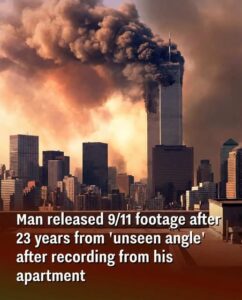
Black smoke was already pouring from the World Trade Center when Kei Sugimoto reached for his camera. From the rooftop of 64 St Marks Place in New York City, the then-24-year-old watched the skyline transform into something almost impossible to understand in real time. At first, he believed he was witnessing a terrible accident. Then he saw the second plane strike. In that instant, the meaning of what was happening changed completely. Sugimoto began recording with a Sony VX2000 fitted with a teleconverter, capturing the towers from a vantage point rarely seen in the footage that would later define September 11, 2001. The resulting video shows smoke billowing across lower Manhattan before the Twin Towers collapse, moments that contributed to the deaths of 2,753 people.
For more than two decades, however, that recording remained unseen by the public. Sugimoto did not film the second plane hitting the tower itself; by his own recollection, seeing that impact was what prompted him to run for the camera. What he did preserve was the aftermath from the north, offering a perspective different from the familiar southern and eastern views that dominated television coverage and documentary archives. The six-minute recording remained among boxes of Hi-8, Digital-8, and DV tapes stored away with the rest of his personal footage. To Sugimoto, it was not a carefully hidden historical artifact waiting for the right anniversary. It was simply part of a collection of aging videotapes he had never fully revisited.
The reason the footage finally surfaced in 2024 was surprisingly ordinary. While cleaning out a closet, Sugimoto discovered the boxes and began checking the tapes. Some had already deteriorated. He said roughly a third appeared to have demagnetized, leaving recordings blank or badly corrupted, and research quickly taught him that magnetic videotape could degrade even under relatively good storage conditions. He began digitizing the collection before more of it was lost. Among those recordings was the September 11 footage. Once uploaded to YouTube, it spread rapidly, with viewers struck by both its clarity and its unfamiliar angle. The reaction carried a haunting implication: history does not always sit safely inside museums or official archives. Sometimes it remains for decades in a cardboard box because the person who recorded it does not yet realize how rare it has become.
The footage arrived as the United States approached the 25th anniversary of the attacks, at a time when investigators were still working to identify victims from the World Trade Center site. In August, New York City officials and the Office of the Chief Medical Examiner announced that another previously unidentified victim, an adult woman, had been identified through forensic investigative genetic genealogy. Her identity was withheld publicly at her family’s request. The identification brought the number of identified World Trade Center victims to 1,654, underscoring how the work of reconstructing September 11 remains unfinished even decades later. Sugimoto’s recording belongs to a very different kind of preservation effort, but the two developments share something important: both show how technology can continue revealing pieces of the past long after the event itself has ended.
What makes Sugimoto’s video compelling is not simply that it offers another angle of a catastrophe the world has seen countless times. It is the reminder that lived history is often scattered across private lives—old tapes, photographs, notebooks, hard drives, and memories that were never meant to become archival material. For twenty-three years, this particular view of September 11 existed quietly in storage while generations came to know the attacks through a familiar set of images. Then one man cleaned out a closet and realized time was beginning to erase what he had recorded. The footage survived because he acted before the tape failed completely. In that sense, its late arrival carries a message beyond the images themselves: even the most documented moments in modern history may still have unseen witnesses waiting to be found.