September 10, 2026 | Miami, Florida
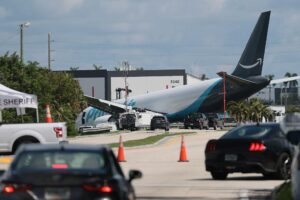
Federal investigators have revealed new details about the final moments before an Amazon Prime Air cargo jet overran a runway at Miami International Airport, killing five people and injuring five others.
According to an investigative update from the National Transportation Safety Board, one of the pilots repeatedly raised concerns that the Boeing 767 was traveling too fast as it approached the runway.
Multiple Warnings Sounded Before Landing
Information recovered from the cockpit voice recorder shows that automated warnings sounded as the aircraft descended rapidly.
Investigators said the cockpit received two “sink rate” warnings, followed by five “too low terrain” alerts.
One pilot continued commenting about the aircraft’s speed, but investigators said the recording did not contain a clear verbal response from the other pilot. The NTSB has not publicly identified which comments came from the captain and which came from the first officer.
Plane Continued Down the Runway
The aircraft nevertheless touched down.
About 15 seconds later, one pilot called for aborting the landing and the engines were increased to a level consistent with attempting a go-around.
At that point, however, the aircraft was approaching the end of the runway while still moving at roughly 120 knots, or 138 mph, according to flight-tracking data cited by Reuters.
Seconds later, the throttles returned to idle and the aircraft left the paved runway.
Five People Were Killed
The 32-year-old Boeing 767, operated by 21 Air for Amazon Prime Air, ultimately traveled roughly 1,300 feet beyond the runway and struck two vehicles.
Five people were killed and another five were injured. The five fatalities were members of a cleaning crew who were inside a van used to transport workers to aircraft.
The flight had arrived from San Juan, Puerto Rico, and the crash occurred Sunday afternoon.
Investigation Is Still Ongoing
Investigators are examining why the crew continued the approach despite the warnings.
The NTSB also said previously that recorded data showed no indication that the aircraft’s speed brakes or thrust reversers had been deployed to help slow the plane.
These findings are preliminary. Investigators have not yet determined the final cause of the crash, and aviation accidents can involve multiple contributing factors.
Source: Reuters / NTSB — September 9–10, 2026.