September 10, 2026 | Galápagos Islands, Ecuador
Scientists are warning that an unusually powerful El Niño could have devastating consequences for some of the world’s most unique wildlife in the Galápagos Islands.
Current projections indicate ocean temperatures in the region could rise about 2.2°C (4°F) above normal, a level considered strong enough to cause major ecological disruption.
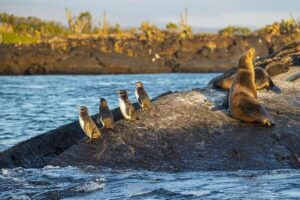
Penguins, Sea Lions and Seabirds Could Be Hit Hard
The Galápagos are home to species found nowhere else on Earth, but warmer ocean water can dramatically reduce the food available to them.
As temperatures rise, plankton, algae and small fish that support the marine food chain can become scarce.
Scientists say Galápagos penguins, blue-footed boobies, sea lions, petrels, flightless cormorants and albatrosses are among the animals potentially at risk.
Without enough food, animal colonies may stop reproducing, disperse in search of food or suffer increased mortality.
Wildlife Population Could Fall by at Least 20%
One of the most alarming estimates comes from scientists monitoring the islands.
If El Niño reaches the projected intensity, the Galápagos’ vertebrate population could decline by at least 20% this year, according to Gustavo Jiménez of the Charles Darwin Foundation.
History shows why researchers are concerned.
After the powerful 1998 El Niño, the Galápagos penguin population fell from approximately 1,300 to only 400, according to Charles Darwin Foundation data cited by AP.
Rare Plants Are Also in Danger
The threat isn’t limited to animals.
Heavy rainfall associated with El Niño could allow invasive plants to spread rapidly, threatening native vegetation including the remaining Scalesia forests and Opuntia cacti.
Conservation teams are already working on emergency measures, including removing invasive plants, collecting seeds and establishing nurseries to preserve vulnerable native species.
Scientists Are Preparing for What Comes Next
The Galápagos Islands are one of the world’s most important natural ecosystems and helped inspire Charles Darwin’s work on evolution.
Scientists cannot yet know exactly how severe the damage will be. But forecasts for an exceptionally strong El Niño have conservationists preparing now rather than waiting for its full effects to appear.
For some of the islands’ rarest animals, the coming months could prove critical.
Source: Associated Press — September 9–10, 2026.